I’ve watched hundreds of professionals start online courses with genuine enthusiasm, only to abandon them two weeks later.
The pattern is predictable. They sign up for a certificate program. They watch a few videos. Life gets busy. The course sits untouched. Guilt accumulates. Eventually, they unsubscribe or let the subscription auto-renew while never logging back in.
The problem isn’t motivation. It’s architecture.
Most people approach online learning like it’s a sprint when it’s actually infrastructure-building. They rely on willpower when they need systems. They chase completion when they should be designing sustainability.
After years of teaching technology and AI to career changers, I’ve identified the specific behavioral frameworks that separate people who finish courses from those who don’t. The difference isn’t discipline. It’s structure.
The Completion Crisis Nobody Talks About
The data on online learning completion is sobering.
The average completion rate for free, open-enrollment online courses sits between 3-15%, with a median around 12.6%. That means for every 100 people who enthusiastically enroll, 80-90 never reach the finish line.
But here’s what most people miss: completion rates aren’t fixed. Structure changes everything.
Courses with coaching and community support see 70%+ completion rates. The same content, different architecture, completely different outcomes.
The critical window is the first two weeks. If someone finishes week two, they typically finish the course. Learner attrition after that point is minimal.
This reveals something important: successful online learning isn’t about sustaining motivation for months. It’s about designing the first 14 days correctly.
Why Traditional Learning Advice Fails Working Professionals
Most learning advice assumes you have time you don’t actually have.
“Study for two hours every evening.” Great, except you have a full-time job, family obligations, and a life that doesn’t pause for your upskilling goals.
“Immerse yourself completely.” Wonderful, but you can’t take a sabbatical to learn data analysis.
The advice that works for students doesn’t translate to professionals who need to learn while maintaining everything else in their lives.
I needed a different approach. One that acknowledged reality instead of pretending it didn’t exist.
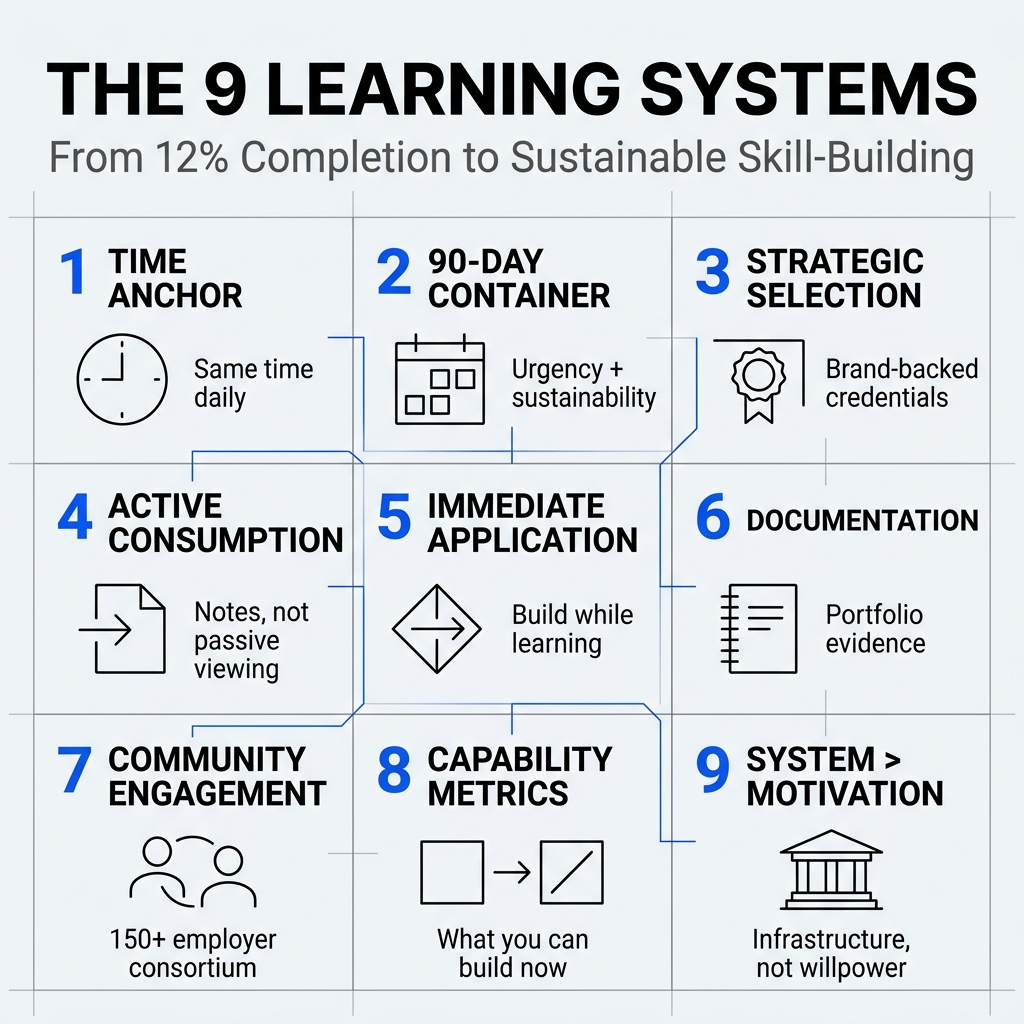
The 9 AM Anchor: Building Around Non-Negotiable Time
I stopped trying to find time and started creating it.
Every morning at 9 AM, I learn. No exceptions. Not “when I have time.” Not “if nothing urgent comes up.” Every single day, 9 AM.
This isn’t about having more discipline than other people. It’s about removing decision-making from the equation.
When learning happens at a specific time every day, you stop negotiating with yourself. You don’t decide whether to study. You just do it, the same way you don’t decide whether to brush your teeth.
The time doesn’t need to be 9 AM. It needs to be consistent and protected.
Some people learn at 6 AM before their household wakes up. Others use lunch breaks. Some protect 8-9 PM after kids go to bed. The specific hour matters less than the reliability.
What makes this work is treating learning time like a standing meeting with yourself that you don’t cancel.
The 90-Day Container: Urgency Without Overwhelm
Vague learning goals produce vague results.
“I want to learn Python” becomes “I will complete the Google Data Analytics Professional Certificate by March 15th.”
The 90-day timeframe isn’t arbitrary. It’s long enough to build meaningful skills and visible results, but short enough to maintain focus and momentum.
Most people can commit to three months. Very few can stay excited about a vague two-year plan.
It’s urgency without overwhelm. The sweet spot.
The time constraint also forces prioritization. When you have 90 days, you can’t waste time on tangential topics or get lost in endless preparation. You focus on what actually moves you toward the outcome.
Most Google Career Certificates are designed for 3-6 month completion at roughly ten hours per week. The programs are already built for this timeframe.
The 90-day container gives your daily 9 AM slot purpose rather than making it feel endless.
Strategic Selection: Choosing Certificates That Actually Matter
Not all certifications carry equal weight in hiring decisions.
I learned this by talking to hiring managers, not by reading platform marketing materials.
The brand behind the certificate matters more than the platform hosting it. Certificates backed by Google, IBM, Meta, and Microsoft consistently outperform generic online credentials in recruiter evaluations.
In fact, 94% of employers accept certificates from these specific companies. Only 62% accept certificates from less-known issuers.
When you list a credential on your resume, format it strategically: “IBM Data Science Professional Certificate via Coursera” reads stronger than “Coursera Data Science Certificate.”
The issuer carries 80% of the weight. The platform is just distribution.
I also prioritize certificates that include hands-on projects. Every Google Professional Certificate program includes real project work. By the time you finish, you have portfolio pieces you can show employers.
The certificate gets you through the application filter. The portfolio proves your capability in the interview.
The Implementation System: How I Actually Learn
Here’s what my daily learning routine actually looks like:
9:00 AM – Learning block begins
I open the course. No email, no Slack, no distractions. Just the learning platform and my notes.
9:00-9:30 – Active consumption
I watch videos or read content, but I don’t passively consume. I take notes in my own words. I pause to think about how this applies to my work. I write down questions.
9:30-9:50 – Immediate application
I do the practice exercises or work on the project component. This is where learning converts to capability. Watching videos creates familiarity. Doing the work creates competence.
9:50-10:00 – Documentation
I write a brief summary of what I learned and what I built. This serves two purposes: it reinforces the learning, and it becomes portfolio documentation I can reference later.
Total time: 60 minutes. Every single day.
This isn’t heroic. It’s sustainable.
The Mistakes I Stopped Making
Early in my online learning journey, I made every common mistake.
I collected courses instead of completing them. I had subscriptions to multiple platforms, dozens of courses saved, and zero certificates earned. I confused access with progress.
I studied without applying. I watched hours of content without building anything. Knowledge without implementation is entertainment, not education.
I waited for perfect conditions. I told myself I’d start when work slowed down, when I had more time, when I felt more prepared. Perfect conditions never arrived.
I relied on motivation. I studied when I felt inspired and skipped when I didn’t. Motivation is unreliable. Systems work regardless of how you feel.
I learned alone. I avoided community features and discussion forums because I thought I could figure everything out independently. Learning in isolation is slower and less effective.
Fixing these mistakes changed everything.
The Community Advantage Most People Ignore
One of Coursera’s most powerful features is the Career Academy Employer Consortium.
This is a network of 150+ companies that explicitly hire from Coursera Professional Certificate completers. The list includes Walmart, Verizon, Deloitte, T-Mobile, and Salesforce.
Most learners have no idea this exists.
When you complete a Professional Certificate, you gain access to career resources and connections with these employers. This isn’t guaranteed placement, but it’s direct access that most candidates don’t have.
I also started engaging in course discussion forums. Not extensively, but strategically. When I got stuck, I asked questions. When others asked questions I could answer, I responded.
This created accountability and accelerated learning. Other people’s questions revealed gaps in my own understanding. Explaining concepts to others reinforced my knowledge.
Learning alone is possible. Learning with others is faster.
Measuring Progress: The Three-Month Checkpoint
The real ROI of online learning appears after completion, not during the course.
According to Coursera’s research on 52,000+ learners, 79% improved their work performance within three months of completing their program. 84% improved or developed key technical skills for their industries.
This three-month application window is where learning converts to career impact.
I track progress differently now. I don’t measure how many videos I watched or how many modules I completed. I measure what I can build that I couldn’t build before.
After completing the Google Data Analytics certificate, could I clean a messy dataset? Could I create visualizations that communicated insights clearly? Could I write SQL queries to extract specific information?
If the answer is yes, the learning worked. If the answer is no, I didn’t apply it correctly.
The certificate is evidence of completion. The portfolio is evidence of capability.
The Sustainability Test: Can You Maintain This for 90 Days?
Before committing to any learning plan, I ask one question: Can I sustain this for 90 days without burning out?
If the answer requires perfect conditions, unlimited energy, or sacrificing everything else in my life, the plan is broken.
Sustainable learning fits into your existing life. It doesn’t require rebuilding your entire schedule or abandoning other responsibilities.
One hour daily at a consistent time is sustainable. Three hours of sporadic study whenever you find time is not.
The goal isn’t to maximize learning intensity. It’s to build a system that keeps working even when motivation fades, when work gets busy, when life gets complicated.
Because life always gets complicated.
What Actually Changed After Building This System
I stopped abandoning courses halfway through. I started finishing what I started.
I stopped feeling guilty about unfinished learning goals. I had a system that worked, so guilt became irrelevant.
I stopped waiting for perfect conditions. I learned in imperfect conditions because my system didn’t require perfection.
I built skills that showed up in my work within weeks, not months. Immediate application meant immediate results.
I stopped collecting courses and started completing certificates. Access without completion is wasted money and wasted time.
The shift wasn’t dramatic. It was architectural.
I didn’t become more disciplined. I built better infrastructure.
The Framework You Can Use
If you’re building your own sustainable learning system, start here:
Pick one certificate. Not three. Not five. One. Complete it before starting another.
Choose a daily time block. Same time every day. Protect it like a standing meeting.
Set a 90-day deadline. Specific end date. Written down. Non-negotiable.
Apply immediately. Don’t just consume content. Build something with what you learn.
Document your work. Every project becomes a portfolio piece. Every learning session becomes evidence of progress.
Engage with community. Ask questions. Answer questions. Learn with others, not alone.
Measure capability, not completion. What can you build now that you couldn’t build before?
This isn’t the only way to learn online. But it’s a way that actually works for people with full-time jobs, real responsibilities, and limited time.
The system is simple. Sustainability comes from simplicity.
Complexity is what you abandon when life gets busy. Simple systems keep working regardless of circumstances.
You don’t need more motivation. You need better architecture.
Build the infrastructure. The results follow.
 La Grande Dieta
Leave a comment