I’ve watched thousands of people start free online courses with genuine excitement. Most of them never finish.
The pattern repeats itself across platforms. Someone discovers a course that could change their career trajectory. They enroll. They watch the first few videos with real engagement. Then life happens. The course sits in their dashboard, mocking them with its 15% completion status.
Here’s what nobody wants to admit: the problem isn’t the quality of free courses. The problem is that we’ve built a psychological association between price and commitment that runs deeper than rational thinking.
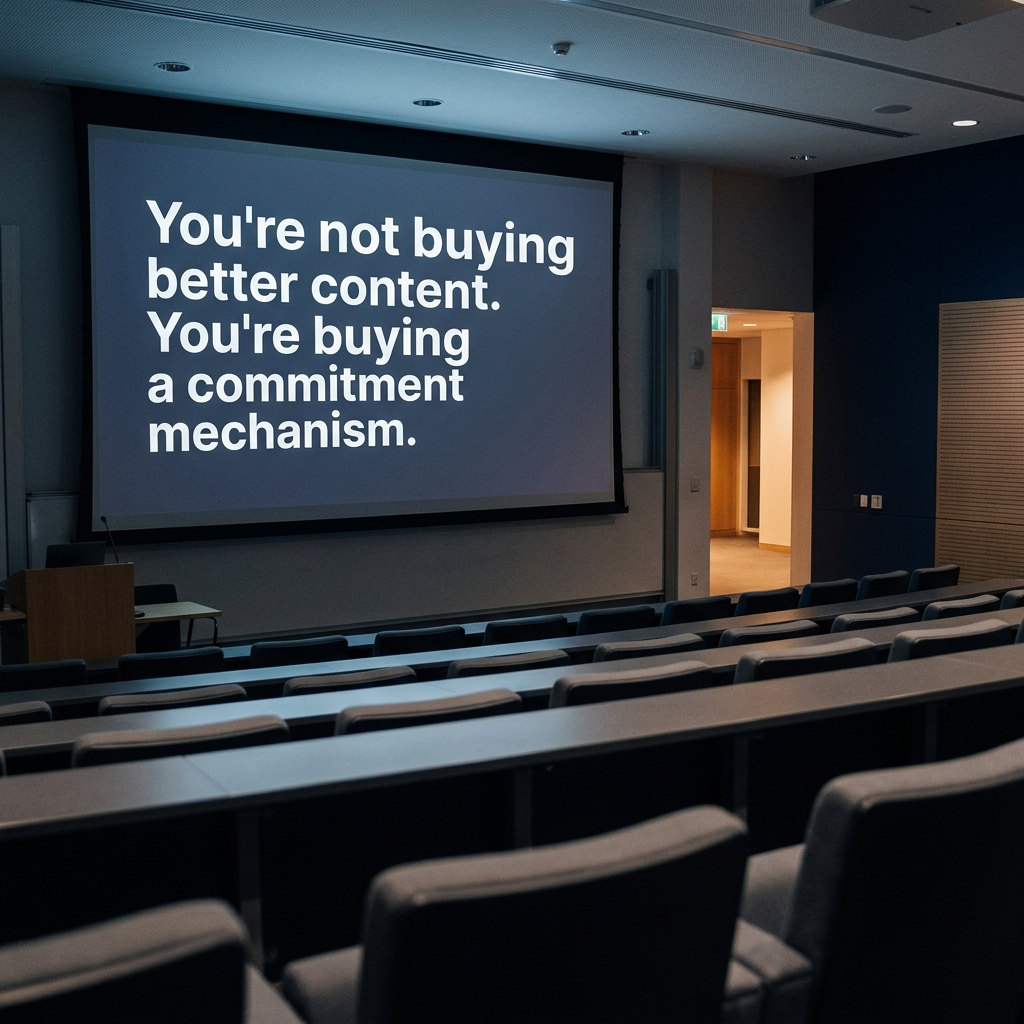
When you pay $49 for a course, you’re not buying better content. You’re buying a commitment mechanism.
The Completion Crisis Nobody Talks About
The data tells a story that most platforms would rather you didn’t see.
Studies show that Coursera courses have completion rates between 10% and 15%. That means 85-90% of people who start a course never finish it.
For MOOCs in general, certification rates range from 2% to 11.2%, with an average of 5.9%. Think about that. Out of every 100 people who enroll, roughly 94 never complete the certification.
But here’s where it gets interesting.
Courses with professional certifications or specializations see completion rates around 40%. That’s nearly four times higher than the average. The difference isn’t the content quality. The difference is the commitment structure built around the learning experience.
Free courses create what I call the illusion of low stakes. You tell yourself you can quit anytime because you haven’t invested anything. This mental escape hatch becomes the reason you actually do quit when the initial excitement fades.
The Hidden Cost of “Free”
I’ve made this mistake myself. I’ve enrolled in dozens of free courses over the years, convinced that I’d found some incredible resource that others were overlooking.
Most of those courses are still sitting at 20-30% completion in my account.
The real cost wasn’t the $0 price tag. The real cost was the time I spent convincing myself I was learning when I was actually just collecting digital bookmarks. The opportunity cost of not committing to one paid program that I would have actually completed.
Free courses often carry the highest total cost when you factor in:
-
Time spent starting and abandoning multiple programs
-
The delayed career advancement from never finishing anything
-
The psychological weight of accumulated incomplete projects
-
The missed network effects from not engaging with committed learning communities
Payment creates what behavioral economists call loss aversion. Once you’ve paid for something, your brain works harder to justify that investment by completing it. This isn’t a character flaw. It’s human psychology working exactly as designed.
Why Motivation Always Fails
You start a course with high motivation. The first week feels exciting. You’re learning new concepts, taking notes, feeling productive.
Then week three hits.
The novelty wears off. The content gets harder. Your job demands more attention. A friend invites you out on the night you planned to study. You skip one session, then another.
With a free course, there’s no friction to quitting. No reminder of money spent. No deadline creating urgency. No community expecting your participation.
Motivation is not a strategy. Motivation is an emotion that fluctuates based on circumstances, energy levels, and competing demands. Building a learning system around motivation guarantees failure for most people.
This is why paid courses show higher completion rates. Payment doesn’t buy you better instruction. It buys you a reason to push through the boring middle section where most learning actually happens.
The Boredom Valley Every Learner Faces
Every course has a predictable arc. The beginning is engaging because everything is new. The end is motivating because you can see the finish line.
The middle is where completion goes to die.
This is the section where you’re no longer excited by novelty but not yet energized by approaching completion. The concepts are harder. The assignments take longer. The initial enthusiasm has evaporated.
Free courses give you permission to quit during this valley. Paid courses make quitting feel like waste. That psychological difference determines whether you gain a marketable skill or just add another abandoned project to your collection.
What Actually Drives Completion
I’ve completed both free and paid courses. The ones I finished had specific characteristics that had nothing to do with price.
Deadline pressure creates urgency. Courses with fixed cohorts and due dates force consistent engagement. You can’t fall behind indefinitely when there’s a schedule to follow.
Community accountability changes behavior. When other people expect your participation in discussions or group projects, you show up differently than when you’re learning in isolation.
Credential value provides external motivation. If completing the course leads to a recognized certification that employers actually care about, you push through difficult sections because the end goal matters.
Financial commitment activates loss aversion. This is the mechanism most people overlook. The pain of wasted money motivates completion more effectively than the pleasure of learning.
Here’s what I’ve observed: professional certifications show completion rates around 40%, compared to 10-15% for general courses. The content quality isn’t four times better. The commitment infrastructure is four times stronger.
The Strategic Case for Paid Learning
This isn’t about whether free courses can teach you valuable skills. They absolutely can. The question is whether you’ll actually complete them.
If you’re someone with exceptional self-discipline who completes 90% of what you start, free courses work fine. But most people aren’t in that category. Most people need external structures to maintain consistency when motivation fades.
Paying for a course is paying for completion infrastructure:
-
Scheduled deadlines that create urgency
-
Community forums where others expect your participation
-
Credentials that carry weight with employers
-
Support systems when you get stuck
-
The psychological weight of financial investment
I’ve seen this pattern repeat across different domains. People who pay for gym memberships attend more consistently than people who work out at home with free YouTube videos. People who hire coaches achieve goals faster than people who read free advice online.
The mechanism is the same. Payment creates commitment. Commitment drives consistency. Consistency produces results.
When Free Actually Works
Free courses do work in specific situations. If you’re exploring a field to see if it interests you before committing, free resources make perfect sense. If you need a specific skill right now and have a concrete project forcing application, free tutorials can be highly effective.
But if your goal is systematic skill development that leads to career advancement, free courses create a trap. You accumulate knowledge fragments without ever reaching the level of competency that changes your market position.
The data supports this. Research shows that 30% of unemployed learners found employment after completing courses on platforms like Coursera. Notice the word “completing.” The people who got hired weren’t the ones who started ten free courses. They were the ones who finished programs that included recognized credentials.
The Real Question You Should Ask
The question isn’t whether free courses are valuable. The question is whether you’ll actually complete them.
If you have a history of starting free courses and not finishing them, that’s not a character flaw. That’s data. You’re trying to build a learning system around motivation when you should be building it around commitment mechanisms.
The cheapest course is the one you complete, regardless of price. A $500 program you finish delivers infinitely more value than ten free courses you abandon at 20% completion.
I’ve watched people spend years accumulating free course enrollments, always planning to come back and finish them later. Meanwhile, others invest in single paid programs, complete them in 90 days, and use those credentials to land better positions or negotiate raises.
The opportunity cost of perpetual free learning exceeds the financial cost of committed paid learning by orders of magnitude.
Building Your Completion System
If you decide to invest in paid learning, make the investment count.
Choose programs with fixed timelines rather than self-paced options. Self-paced sounds flexible, but flexibility often means indefinite delay. Fixed schedules create urgency.
Select courses with active communities. Learning in isolation makes quitting easy. Learning alongside others who expect your participation changes your behavior.
Prioritize credentials that employers recognize. Generic certificates carry less weight than programs affiliated with recognized institutions or companies. Research shows that more than 90% of employers prefer candidates with microcredentials over those without.
Set completion as the primary goal, not perfect understanding. You learn more from finishing an imperfect course than from abandoning a perfect one at 30% completion.
Track your completion rate as a key metric. If you’re consistently finishing less than 50% of courses you start, your selection criteria needs adjustment. You’re choosing based on interest rather than realistic assessment of commitment capacity.
What This Means for Your Career
The shift toward skills-based hiring creates unprecedented opportunity for people willing to demonstrate competency through alternative credentials.
But opportunity only converts to outcomes through completion. Employers don’t hire people who started impressive courses. They hire people who finished them and can demonstrate the resulting capabilities.
The completion gap separates people who use online learning as genuine career infrastructure from people who use it as aspirational entertainment. Both groups enroll in courses. Only one group changes their economic position.
You probably don’t need more courses. You need to finish the ones you start. And for most people, that requires commitment mechanisms stronger than motivation alone.
The price isn’t buying knowledge. The knowledge is already available for free. The price is buying the structure that ensures you actually acquire the knowledge instead of just browsing it.
That structure is worth far more than the subscription fee.
 La Grande Dieta
Leave a comment