I’ve spent years watching people collect certificates like merit badges, convinced each one brings them closer to their dream job.
The pattern is predictable: someone completes a Google Data Analytics certificate, updates their LinkedIn, and waits for interview requests that never come. Then they blame the certificate, the platform, or the entire concept of online learning.
But here’s what I’ve learned from talking to hiring managers, analyzing recruitment data, and watching hundreds of career transitions: the certificate itself was never the problem.
The problem is misunderstanding what the certificate actually does.
The Real Function of an Online Certificate
When a recruiter sees an online certificate on your resume, they’re not thinking “This person can do the job.”
They’re thinking “This person is making an effort to learn.”
That’s it. That’s the entire transaction in their mind.
The certificate buys you curiosity points. It signals initiative, willingness to invest in growth, and awareness of skill gaps. These matter, but they don’t close the deal.
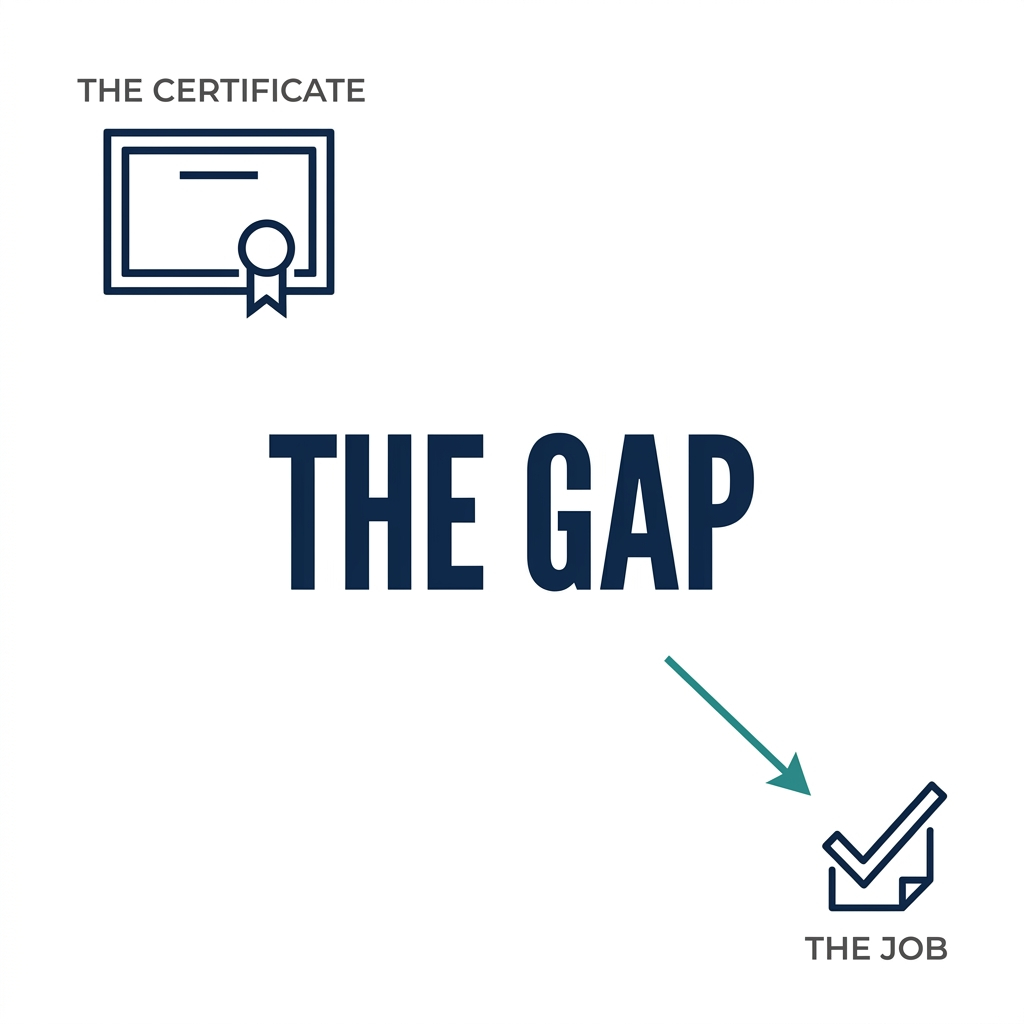
What closes the deal is proof.
Hiring managers say yes when they see evidence that you’ve applied your skills through projects, results, experience, or a portfolio. Not just learned about them.
According to recruitment data, more than 60% of talent professionals state that relevance of coursework to actual job tasks greatly impacts hiring decisions. They’re not evaluating whether you completed something. They’re evaluating whether what you completed connects to what they need done.
The certificate gets you in the room. The portfolio gets you the job.
Why Some Certificates Carry More Weight Than Others
Not all online certificates generate the same level of recruiter interest.
I’ve seen this play out repeatedly: two people complete certificates in the same domain, but one gets interviews while the other gets silence. The difference isn’t effort or intelligence.
It’s brand recognition and employer alignment.
Certificates backed by Google, IBM, Meta, and Microsoft consistently outperform generic online credentials in recruiter surveys. When a hiring manager sees “Google Data Analytics Professional Certificate” on a resume, they recognize the issuer first and the platform second.
This creates a hidden hierarchy within online learning. Over 70% of employers consider accreditation essential when evaluating online credentials, but brand-name recognition creates even stronger differentiation.
The strategic implication: not all certifications deliver equal career impact, even from the same platform.
Google Career Certificates demonstrate this clearly. In the U.S. alone, over 350,000 people have earned these credentials, and 75% of certificate graduates report a positive career outcome within six months of completion.
That outcome rate isn’t random. It reflects deliberate employer partnerships: Google Career Certificates are used by 800+ U.S. colleges and 2,000 businesses, with 150+ employers actively committed to considering program graduates for hiring.
This is what genuine employer buy-in looks like, beyond marketing claims.
The Perception Gap Between Learners and Employers
Here’s where things get interesting.
58% of hiring managers consider online certifications just as valuable as traditional degrees. That sounds encouraging until you understand what “just as valuable” actually means in practice.
It means the certificate doesn’t automatically disqualify you. It means you’re in the consideration pool.
It doesn’t mean the certificate alone gets you hired.
The perception gap exists because learners often treat certificates as credentials that prove capability, while employers treat them as signals that suggest potential.
Employers evaluate awareness, readiness, credentials, and reputation when making hiring decisions. The certificate addresses credentials, but the other three factors determine whether you actually get the offer.
This is why two candidates with identical certificates can have completely different hiring outcomes. One has built a portfolio demonstrating applied skills. The other has only the certificate.
The market rewards the first candidate and ignores the second.
What Actually Happens After You Earn a Certificate
The data on post-certificate outcomes reveals a pattern most people miss.
68% of learners who take an online course say digital courses helped them advance in their careers. But advancement means different things: promotion, salary increase, new role, expanded responsibilities, or career transition.
The most concrete metric is salary impact. Online courses boost salaries by an average of 21% within one year of completion among certificate earners. But this doesn’t happen automatically.
The salary increase correlates with how you position the certificate within your professional narrative.
Did you complete a data analytics certificate and immediately start using those skills in your current role, creating measurable business impact? That leads to promotion or raise conversations.
Did you complete the same certificate but never apply it? The salary impact approaches zero.
The certificate creates opportunity. Application creates outcomes.
This explains why 87% of learners reported measurable career benefits within six months of completing a certificate, while others see no change at all. The difference isn’t the certificate quality. It’s the implementation strategy.
The Hidden Barrier: Completion Rates
Before you can leverage a certificate, you have to finish it.
This is where most online learning attempts fail.
The average online course completion rate falls between 10% and 20%. That means for every 100 people who enroll, 80-90 never reach the finish line.
Free online courses see completion rates of only 5-15%. Paid courses perform slightly better at 15-40%, but still represent massive dropout rates.
The completion gap reveals something critical: motivation doesn’t sustain learning behavior.
What does? Structure and accountability.
Courses with coaching and community support see 70%+ completion rates, compared to 10-15% for self-paced courses. This demonstrates that learning systems and behavioral frameworks matter more than willpower alone.
The professionals who successfully complete certificates and convert them into career outcomes aren’t more disciplined. They’ve built learning infrastructure that doesn’t depend on daily motivation.
The Working Professional Reality
55% of people worked full-time while earning their certificate.
This isn’t a minor detail. It’s the defining constraint that determines whether online learning works for you.
The median age of online undergraduate students is 29. For graduate students, it’s 32. This isn’t traditional education. It’s career development under time pressure.
The primary barrier isn’t intellectual capacity or course difficulty. It’s consistency.
Can you maintain learning momentum while managing full-time work, family responsibilities, and everything else competing for your attention?
The answer determines whether the certificate becomes a career asset or another abandoned project.
This is why rapid skill acquisition frameworks matter. Time-bound models like 90-day upskilling blueprints combat the endless learning trap where professionals perpetually consume content without reaching marketable competency.
Artificial constraints and defined endpoints increase completion rates and practical application.
The Urgency Behind Continuous Learning
The World Economic Forum’s 2025 Future of Jobs Report projects that employers expect 39% of key job skills will change by 2030.
That’s not a distant future scenario. That’s a five-year window.
The current skills gap is already severe: while 92% of jobs now require digital skills, only one-third of workers possess the necessary skills for their roles.
Even more striking, 40% of employees will need to acquire new skills within the next five years just to stay relevant in their current positions.
This validates something I’ve been saying for years: career stability now depends on perpetual learning capacity, not static credentials.
The certificate isn’t the destination. It’s infrastructure for continuous skill acquisition in markets that move faster than institutions can adapt.
What This Means for Your Strategy
If you’re considering an online certificate, here’s what actually matters:
Choose certificates with employer recognition. Google, IBM, Meta, and Microsoft credentials carry weight because hiring managers recognize these brands independently of the platform. The issuer matters as much as the content.
Plan for application before you enroll. Don’t collect certificates hoping they’ll create opportunities. Identify how you’ll apply the skills immediately, then pursue the certificate as a structured learning path toward that application.
Build completion infrastructure. If you’re working full-time, motivation won’t sustain you through a 3-6 month program. You need learning systems that function regardless of how you feel on any given day.
Create proof of capability. The certificate signals potential. Your portfolio, projects, and demonstrated results prove capability. Allocate time to building both simultaneously.
Understand the timeline. 75% of certificate graduates report positive career outcomes within six months. That’s your benchmark. If you’re not seeing movement within that window, your implementation strategy needs adjustment.
The Real Value Proposition
Online certificates don’t replace experience, portfolios, or demonstrated capability.
They provide structured learning paths that compress skill acquisition timelines and signal commitment to growth.
When you understand this, the question shifts from “Will this certificate get me hired?” to “How do I use this certificate as part of a broader capability-building strategy?”
That second question leads to better outcomes.
The certificate gets you in the room. What you’ve built with those skills gets you the job.
The professionals who succeed with online learning understand this distinction. They don’t treat certificates as magic credentials. They treat them as structured frameworks for acquiring skills they immediately apply to create measurable results.
That’s the difference between collecting certificates and building careers.
 La Grande Dieta
Leave a comment