
I never talked myself out of something with my own intelligence.
Someone else had to do it.
The good thing is, once someone does that, I talk myself into listening. And that is what makes the difference. Sometimes it was a colleague, sometimes a random person I shared my ideas with. The pattern became clear after years of watching my own thinking: Smart people only get stuck when they keep their ideas to themselves.
Because the intelligence that traps you is the same intelligence that, once it hits another mind, finds the flaw in its own argument.
The conversation does what the thinking alone cannot.
The Paradox of Individual Intelligence
Your brain is a powerful machine. It builds arguments, connects dots, and generates insights at remarkable speed. But here’s what nobody tells you about intelligence: it’s also a perfect echo chamber.
When you think alone, your thoughts bounce around inside the same cognitive architecture that created them. The same logic that built your argument is the only logic evaluating it. The same assumptions that shaped your thinking are the only assumptions checking your work.
You end up with a closed loop.
I’ve watched brilliant people spend weeks refining an idea that had a fundamental flaw visible in the first five minutes to someone else. The flaw wasn’t hidden. It was just invisible to the person who created it. Their intelligence had built a beautiful structure around a cracked foundation, and every addition made the structure more elaborate but no more sound.
This happens because intelligence doesn’t automatically include perspective. You can be exceptionally smart and completely blind to the holes in your own reasoning. The smarter you are, the better you become at defending positions that might be wrong.
Why Articulation Changes Everything
Something shifts when you speak an idea out loud to another person.
The act of translating thought into language forces clarity. You can’t hide behind vague concepts or skip logical steps when someone else is listening. You have to make it make sense to a mind that doesn’t already agree with you.
And in that translation, you hear yourself differently.
I’ve started explaining an idea to someone and stopped mid-sentence because I heard the flaw as the words left my mouth. The other person didn’t say anything. They didn’t have to. The act of articulation did the work.
But articulation alone isn’t enough. You need the other person there. You need their presence, their questions, their different way of processing information. Because even if they don’t spot the problem, their existence as an audience changes how you think.
When you think alone, you think in shortcuts. You skip steps because you already know what you mean. When you explain to someone else, you have to walk the entire path. And walking that path reveals the places where the ground isn’t solid.
The Mirror Effect
Other people function as mirrors for your thinking.
Not because they’re smarter than you. Not because they have better ideas. But because they reflect your logic back to you from a different angle. They show you what your thinking looks like from the outside.
A colleague once challenged a strategy I’d spent days developing. Her question was simple: “Why are you assuming that part?” I had no good answer. The assumption was buried so deep in my thinking that I’d stopped seeing it as an assumption. It had become a fact in my mind.
She didn’t solve my problem. She just showed me where the problem actually was.
That’s what the mirror does. It doesn’t fix your thinking. It reveals what your thinking actually looks like, stripped of the internal narrative that makes everything seem coherent when you’re alone with it.
Random conversations work the same way. The person doesn’t need expertise in your field. They just need to be genuinely trying to understand what you’re saying. Their confusion points to your gaps. Their questions highlight your leaps. Their perspective shows you the assumptions you didn’t know you were making.
The Cost of Isolation
Smart people get stuck because they trust their own intelligence too much.
You’ve been right before. Your thinking has solved problems. Your analysis has proven accurate. So when you develop a new idea or strategy, you assume your internal quality control is enough.
It’s not.
Isolation breeds confidence without calibration. You become increasingly certain about ideas that haven’t been tested against external reality. Your intelligence becomes a closed system, generating heat but no light.
I’ve seen teams where the smartest person in the room stopped sharing ideas early. They’d develop complete strategies alone, then present finished thinking. The strategies were often impressive. They were also often wrong in ways that would have been obvious if anyone else had been involved earlier.
The pattern repeats across industries and contexts. The brilliant engineer who designs an elegant solution to the wrong problem. The executive who develops a strategy based on assumptions nobody shares. The researcher who pursues a question that seemed important in isolation but misses the mark.
The intelligence was real. The isolation was the problem.
What Conversation Actually Does
Conversation isn’t just information exchange. It’s a cognitive process that works differently than individual thinking.
When you think alone, you follow your natural patterns. You gravitate toward familiar frameworks. You see what you’re primed to see. Your blind spots stay blind because you can’t see what you can’t see.
When you talk with someone else, you’re forced to navigate their cognitive patterns too. You have to bridge the gap between your understanding and theirs. That bridging work reveals things.
The other person asks questions you wouldn’t ask yourself. They get confused by things you thought were clear. They connect your idea to contexts you hadn’t considered. They bring different experiences, different assumptions, different ways of breaking down problems.
And in responding to them, you think differently than you would alone.
You defend points you hadn’t realized needed defending. You clarify distinctions you’d been fuzzy about. You encounter resistance that forces you to examine whether your reasoning actually holds up under pressure.
Sometimes the conversation validates your thinking. Sometimes it reveals fatal flaws. Both outcomes are valuable. Both require another person.
The Humility Factor
There’s a humility required to seek out other perspectives.
You have to acknowledge that your intelligence, however sharp, has limits. You have to accept that being smart doesn’t make you right. You have to admit that the thinking you did alone might be incomplete or flawed.
This humility doesn’t come naturally to people who’ve succeeded based on their intellectual capabilities. If your intelligence has been your primary tool for navigating the world, trusting it completely feels rational.
But true intelligence includes knowing when you need external input.
The smartest people I know are quick to share half-formed ideas. They test their thinking early and often. They seek out people who’ll push back. They value conversation not as a way to broadcast their conclusions but as a way to improve their thinking.
They’ve learned that intelligence without feedback is intelligence running in place. You can think harder, longer, more carefully. But if you’re thinking alone, you’re thinking within the same constraints that created the problem.
Building Better Thinking Environments
Organizations that understand this create space for ideas to collide.
They don’t just encourage collaboration. They structure work so that ideas get exposed to other minds early. They build cultures where sharing incomplete thinking is normal and safe. They recognize that the best ideas emerge from conversation, not from isolated genius.
This means creating environments where people can say “I’m stuck on this” without it being a weakness. Where asking for input is seen as smart, not as incompetence. Where the default is to share and discuss, not to develop and present.
It also means recognizing that the person who helps you see the flaw doesn’t need to be an expert. Sometimes the most valuable feedback comes from someone outside your field, someone who doesn’t share your assumptions, someone who asks the obvious questions you stopped asking yourself years ago.
The goal isn’t to crowdsource every decision. It’s to ensure that your thinking gets tested against reality before you commit to it fully.
The Practice of Thinking Out Loud
You can build this into your own practice.
Share ideas earlier than feels comfortable. Talk through your thinking before it’s fully formed. Find people who’ll engage with your ideas honestly, not just affirm them.
When you’re stuck, your first move should be to talk to someone. Not to get their solution. Not to hand them the problem. But to explain your thinking and see what happens when it meets another mind.
Pay attention to the moments when you hear yourself say something and immediately know it’s wrong. Those moments are gold. They’re your intelligence working properly, enabled by the external catalyst of another person’s attention.
Notice when someone’s confusion reveals your own unclear thinking. When their question exposes your assumption. When their different perspective shows you what you’d been missing.
The conversation does what thinking alone cannot. Not because conversation is magic. But because your intelligence needs another intelligence to work against in order to find its own edges and gaps.
Moving Forward
Smart people do not lack the ability to move. They lack the mirror.
The intelligence that traps you is the same intelligence that, once it encounters another mind, finds its own flaws and fixes them. But that encounter has to happen. The conversation has to occur.
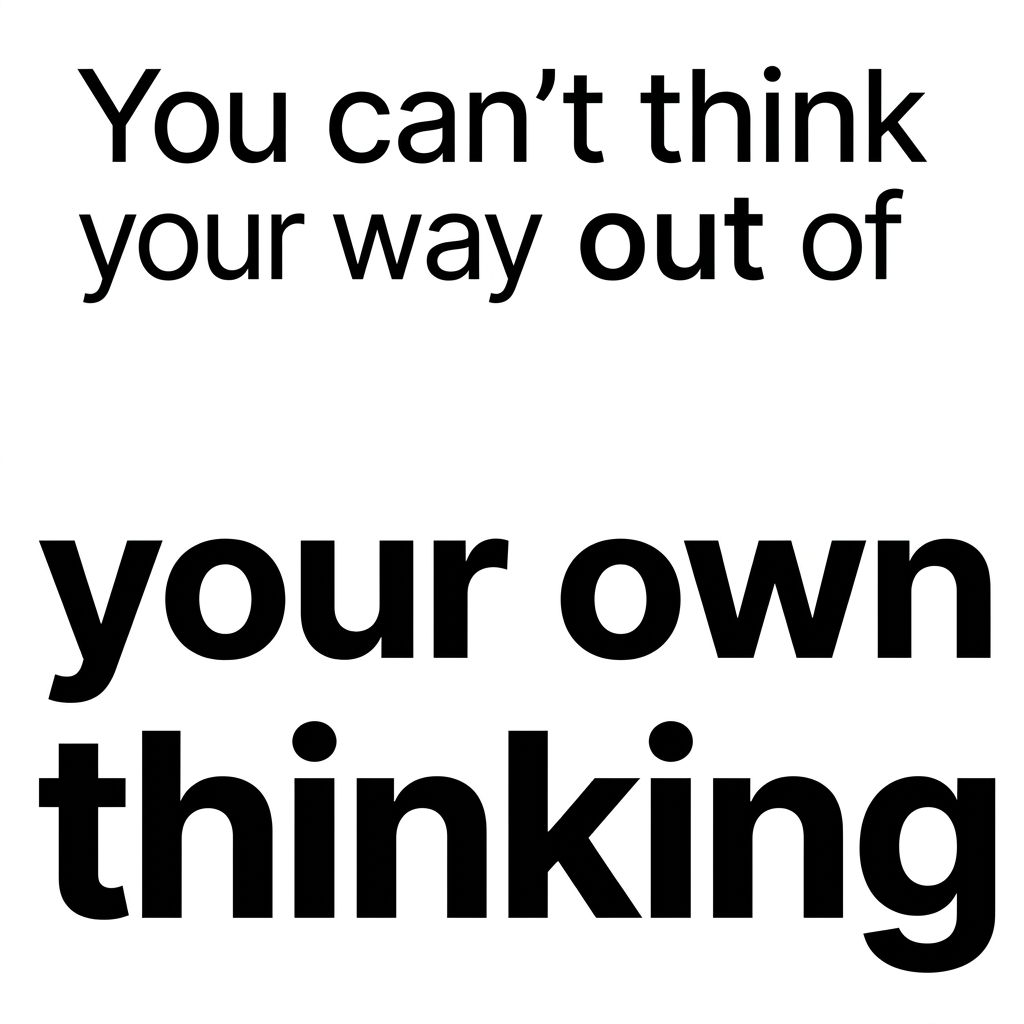
You can’t think your way out of your own thinking. You need someone else to create the conditions where your intelligence can work on itself.
This isn’t a limitation. It’s how intelligence actually works when it works well.
The question isn’t whether you’re smart enough to solve your problems alone. The question is whether you’re smart enough to recognize when you need to stop thinking alone.
Because the best thinking happens when intelligence meets intelligence, when your logic encounters someone else’s perspective, when your assumptions get tested against a different set of experiences.
That’s where ideas get better. That’s where stuck becomes unstuck. That’s where your intelligence finally gets the mirror it needs to see itself clearly.
And once you see clearly, you can move.
 La Grande Dieta
Leave a comment