
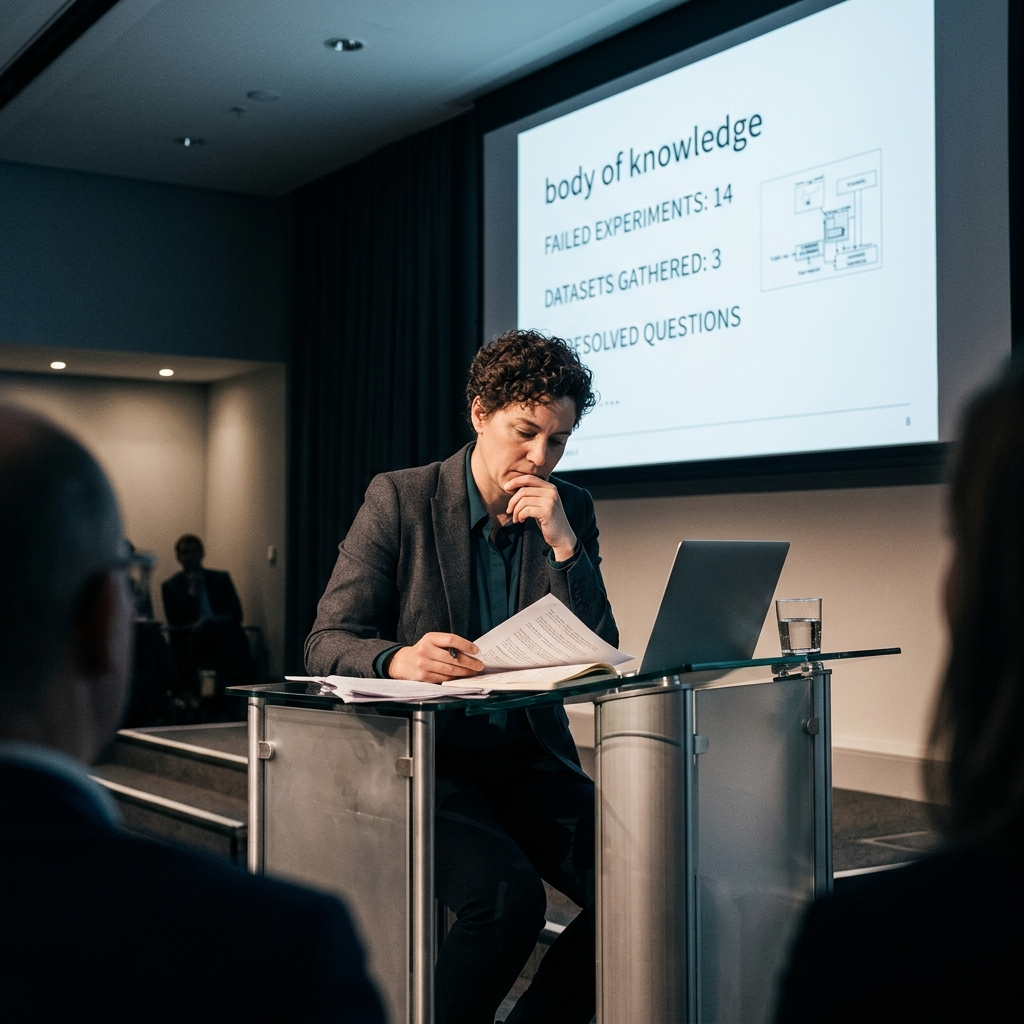
I sat in front of my presentation slides last month and felt something shift.
The work was solid. The results were interesting. But the question that surfaced wasn’t about the work itself.
It was: Am I presenting this because it matters, or because I want people to see me presenting?
That question changed everything. Because the moment you ask it, you realize something uncomfortable about the entire “building in public” movement we’ve all been swept into.
We’ve confused transparency with performance.
The Moment Building in Public Lost Its Soul
Building in public started as something useful. Share your process. Show your work. Help others learn from what you’re doing.
Then it became a strategy.
Now we have people optimizing their “authentic updates” for engagement. Crafting their “raw behind-the-scenes” content for maximum reach. Scheduling their “unfiltered thoughts” at peak posting times.
The infrastructure of attention corrupted the intent.
You can feel it when you scroll through your feed. Someone shares a “failure” but it’s wrapped in inspirational framing. Someone posts their “messy process” but every screenshot is carefully cropped. Someone documents their “real journey” but only the parts that make them look resilient, resourceful, or relatable.
The performance of transparency has replaced actual transparency.
And here’s what makes it insidious: you can’t always tell the difference from the outside. Sometimes even the person posting can’t tell anymore.
The Question That Reveals Everything
Am I doing this for the attention or for the work?
This is the dividing line. This is where you find out what you’re actually building.
When I asked myself that question about my presentation, I had to sit with the answer. Part of me wanted the visibility. Part of me wanted the validation. Part of me was thinking about how this would look on my CV, in my portfolio, in the eyes of people I respect.
Those motivations aren’t evil. They’re human.
But they change what you share and how you share it. They change what you emphasize and what you hide. They change transparency from a tool for collective progress into a tool for personal advancement.
The work becomes secondary to the narrative about the work.
What Science Gets Right About Sharing Failure
There’s a version of transparency that still feels real, and it comes from an unexpected place: scientific research.
In science, you publish your failures.
Not because it makes you look good. Not because it builds your personal brand. Not because it gets engagement.
You publish failures so the next person doesn’t waste a year of their life on the same dead end.
This is transparency with a different motivation. The goal isn’t to showcase your journey or demonstrate your resilience. The goal is to contribute to a body of knowledge that exists beyond you.
When a research team publishes negative results, they’re saying: we tried this approach, it didn’t work, here’s why we think it failed, here’s what we learned. They’re not framing it as a “failure story” with inspirational lessons. They’re documenting what happened so others can build on that information.
The difference is subtle but fundamental.
One approach treats failure as content. The other treats failure as data.
One approach centers the person. The other centers the knowledge.
Personal Brand vs. Body of Knowledge
The phrase “personal brand” has done something strange to how we think about sharing our work.
It’s made us believe that everything we put out into the world should reinforce a coherent narrative about who we are. Every post should align with our positioning. Every update should serve our reputation.
This creates a filter. You start asking: does this make me look good? Does this fit my brand? Will this help or hurt my image?
Those questions push you away from useful transparency.
Because useful transparency often looks messy. It includes the experiments that went nowhere. The hypotheses that were wrong. The approaches that seemed promising but turned out to be dead ends.
A body of knowledge includes all the paths that didn’t work.
A personal brand only includes the paths that make you look smart.
When you optimize for personal brand, you end up sharing a curated version of your work. The version that makes you look insightful, capable, ahead of the curve. You share the wins and the “productive failures” that taught you something quotable.
You don’t share the boring failures. The ones that just didn’t work for unclear reasons. The experiments that consumed weeks and produced nothing interesting. The ideas that were simply wrong.
But that’s exactly the information that would be most useful to someone else.
The Trust Problem We’re Creating
Here’s what happens when building in public becomes performance: people stop trusting what they see.
When your audience knows you’re optimizing for attention, they start reading between the lines. They assume you’re hiding the real problems. They suspect the “authentic” moments are staged. They question whether your failures are actually failures or just strategic vulnerability.
This creates a strange dynamic where everyone is performing transparency while no one believes anyone else’s performance.
We end up with a culture that looks transparent on the surface but is actually more opaque than before. At least when people kept their work private, you didn’t have to sort through layers of performed authenticity to figure out what was real.
The scientific model avoids this problem because it removes the performer from the performance. When you publish research, the focus is on the methodology, the results, the implications. Your personal journey matters less than the knowledge you’re contributing.
You’re not asking people to trust your authenticity. You’re asking them to evaluate your data.
What Changes When You Build for the Body of Knowledge
I’ve started asking myself a different question before I share anything publicly: Would this be useful to someone even if my name wasn’t attached to it?
That question strips away the personal brand considerations. It forces me to evaluate whether I’m contributing information or just contributing to my image.
When you build for the body of knowledge instead of the personal brand, several things shift:
You share different information. The boring failures become relevant because they save someone else time. The inconclusive experiments matter because they narrow the search space. The “I don’t know” moments are valuable because they mark the edges of current understanding.
You write differently. Less narrative framing. Less personal journey. More direct documentation of what you tried, what happened, what you learned.
You measure success differently. The goal isn’t engagement or followers or personal recognition. The goal is whether someone else can use what you shared to make progress faster than they would have without it.
This doesn’t mean you can’t have a personal brand. It means your personal brand becomes a byproduct of useful contribution rather than the primary goal.
The Practical Test
Here’s how you know if you’re building in public for the right reasons:
Would you still share this if you knew it would get zero engagement?
If the answer is no, you’re optimizing for attention. If the answer is yes, you might be contributing to something larger.
This test isn’t about moral superiority. It’s about clarity. It helps you understand your own motivations so you can make intentional choices about what you share and why.
Sometimes the answer will be no, and that’s fine. There’s nothing wrong with wanting attention or building a reputation. But it helps to know when that’s what you’re doing.
Because when you confuse attention-seeking with knowledge-building, you end up doing neither well.
Rebuilding Transparency
The solution isn’t to stop building in public. The solution is to rebuild it with different foundations.
Start with the assumption that your work is part of a larger body of knowledge that will outlive your personal brand. Share information that advances that body of knowledge, even when it doesn’t advance your image.
Document your dead ends. Not as inspirational failure stories, but as data points that help others navigate the same territory.
Be specific about what worked and what didn’t. Not in a “here’s my journey” way, but in a “here are the conditions under which this approach succeeded or failed” way.
Remove yourself from the center of the story. The work should be able to stand without your personal narrative wrapped around it.
This kind of transparency is harder. It doesn’t optimize for engagement. It won’t necessarily build your follower count. It might not even feel satisfying in the moment because you’re not getting the validation hit that comes from a well-received personal update.
But it builds something more durable than a personal brand.
It builds knowledge that compounds.
The Real Question
The next time you’re about to share your work publicly, pause for a moment.
Ask yourself: am I doing this for the attention or for the work?
If you’re honest with the answer, you’ll know exactly what you’re building.
And you’ll know whether it’s something that will matter after the attention fades.
Because attention always fades. But a body of knowledge grows.
That’s the difference between building a brand and building something that lasts.
 La Grande Dieta
Leave a comment