
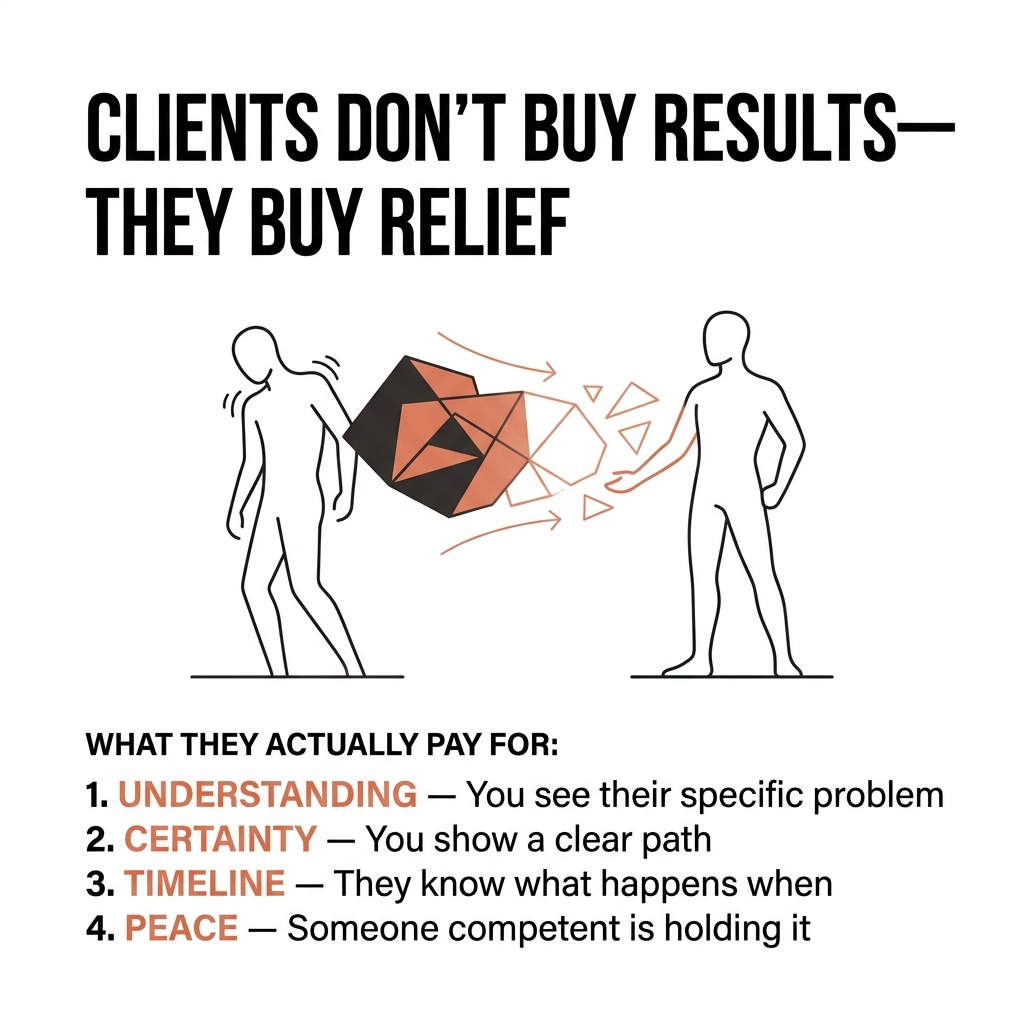
You think clients hire you for results. That’s half true.
You think they pay for your time and expertise. That’s part of the equation.
But here’s what actually closes deals and keeps clients coming back: relief.
Not the results themselves. Not even the promise of results. The feeling that someone competent is holding their problem. The sensation of a weight lifting off their shoulders before you’ve done a single hour of billable work.
Most service providers focus on what they deliver. The smart ones focus on what the client stops carrying.
What Clients Actually Buy
When someone hires you, they’re making a trade. They give you money. You give them something back.
The surface transaction looks straightforward: results in exchange for payment. You’ll build the website, write the strategy, design the system, manage the campaign.
But watch what happens in the moment they decide to hire you. Watch their shoulders drop. Listen to how their voice changes. They’re experiencing relief before you’ve opened your laptop.
They’re buying the feeling that someone else is holding the problem.
This changes everything about how you position your services. Your technical skills matter. Your portfolio matters. Your process matters. But none of that creates the emotional shift that turns a prospect into a client.
That shift happens when you demonstrate that you understand their specific problem and that you have a clear path to solving it.
The Architecture of Trust
Here’s where most service providers lose the thread. They think project management is about tracking tasks, hitting milestones, and delivering on time.
That’s not project management. That’s trust architecture.
The quick plan you show a client before the detailed plan? That’s not a preview. That’s a trust signal.
The timeline you provide before work begins? That’s not scheduling. That’s certainty in concrete form.
You’re building the structure that allows a client to stop worrying. You’re creating the framework that lets them redirect their mental energy from “Will this work?” to “What will I do with the results?”
This happens in stages, and each stage has a specific job:
First, understand their problem. Not the problem you think they have. Not the problem your last three clients had. Their specific problem, with all its context and constraints.
Second, make sure they know you understand. Repeat it back to them. Show them you’ve grasped the nuances. Demonstrate that you see what they see.
Third, show them a quick plan. Not the full project plan with every task and dependency. A clear, simple outline that shows you know where you’re going.
Fourth, give them a timeline. Specific dates. Clear milestones. Concrete expectations they can hold onto.
Each of these steps builds certainty. Each one reduces the client’s cognitive load. Each one makes it easier for them to trust that you’ll deliver.
You’re selling certainty before you even start the work.
Why Skill Alone Doesn’t Keep Clients
Your technical expertise gets you in the room. Your ability to create certainty keeps you there.
Think about the last time you hired someone for something important. A lawyer for a complex case. A contractor for a major renovation. A specialist for a health concern.
You probably evaluated their credentials. You checked their experience. You looked at their track record.
But what made you feel good about hiring them? What let you sleep better that night?
It wasn’t their resume. It was the way they explained what would happen next. The clarity they provided about the process. The confidence they projected about handling the inevitable complications.
Your clients experience the same thing. They come to you with a problem that’s been keeping them up at night. They need someone who can solve it. But more immediately, they need someone who can carry it.
The difference between a one-time project and a long-term client relationship often comes down to this: Did you reduce their anxiety, or did you add to it?
When you deliver results but create stress along the way, you’ve completed the project but damaged the relationship. When you deliver results and reduce stress throughout the process, you’ve created a client who will hire you again and refer others.
The Quick Plan as a Trust Signal
Let’s talk about that quick plan in more detail, because this is where many service providers stumble.
You might think clients want to see your full methodology. Your complete process. Every step laid out in detail.
They don’t. Not at first.
What they want is proof that you have a plan. Evidence that you’ve done this before. Confidence that you’re not figuring it out as you go.
The quick plan serves this purpose. It’s a summary, not a specification. It shows the major phases, the key decisions, the critical milestones. It demonstrates that you understand the journey from problem to solution.
Here’s what a quick plan communicates:
You’ve seen this before. You’re not experimenting on their dime. You have a proven approach.
You know the terrain. You understand where the challenges will appear and how to handle them.
You can explain it clearly. If you can break down a complex project into understandable phases, you can probably execute it.
The detailed plan comes later. The quick plan comes early, when the client most needs reassurance.
Timeline as Certainty
Timelines do something powerful in the client’s mind. They transform an abstract future into a concrete sequence of events.
“We’ll get this done” creates hope. “We’ll complete phase one by March 15th, phase two by April 30th, and deliver final results by May 20th” creates certainty.
The timeline doesn’t just tell the client when things will happen. It tells them you’ve thought through the work. You’ve estimated the effort. You’ve accounted for dependencies and potential delays.
You’ve done the mental work they were doing in their head, trying to figure out if this project would take three weeks or three months.
That’s relief in action.
The timeline also creates accountability. When you commit to specific dates, you’re taking responsibility for the schedule. The client can stop wondering and start planning around your commitments.
This is why vague timelines create anxiety. “It’ll take a few weeks” leaves the client holding the uncertainty. “We’ll deliver the first draft on Tuesday, March 12th” lets them put it down.
Building This Into Your Process
You can integrate this approach into every client interaction, starting with your first conversation.
When a prospect describes their problem, your first job is to understand it fully. Ask questions. Clarify details. Make sure you’re seeing what they’re seeing.
Then, before you talk about your services or your pricing, demonstrate that understanding. Say back to them what you heard. Show them you’ve grasped the situation.
Watch what happens when you do this. The prospect relaxes. They lean back slightly. They nod. You’ve created the first moment of relief.
Next, outline your approach. Not your full proposal. Just the basic path: “Here’s how we’d tackle this. First, we’d do X. Then we’d move to Y. Finally, we’d deliver Z.”
Give them the timeline: “This would take about six weeks. We’d spend the first two weeks on discovery and planning. Weeks three and four would be execution. Weeks five and six would be refinement and delivery.”
You’ve now created certainty. The prospect can visualize the project. They can see the path from problem to solution. They can imagine life after the project is complete.
That’s when they’re ready to talk about price and terms. That’s when the sale becomes natural.
The Difference Between Good and Great
Good service providers deliver results. Great service providers deliver results while reducing client anxiety at every step.
Good service providers manage projects. Great service providers build trust architecture.
Good service providers focus on their deliverables. Great service providers focus on their client’s experience of the process.
The technical work matters. You need to be skilled at what you do. You need to deliver quality results on time.
But in a market where many people can do good technical work, the differentiator is how you make clients feel throughout the engagement.
Do they feel confident or anxious? Informed or confused? Certain or uncertain?
Your ability to create and maintain certainty determines whether you get hired, whether you get hired again, and whether you get referred.
What This Means for Your Business
If you’re a service provider, consultant, freelancer, or agency owner, this insight should reshape how you approach client relationships.
Start measuring your success not just by project completion but by client relief. Did you reduce their anxiety? Did you make the process feel manageable? Did you create certainty where there was uncertainty?
Build trust architecture into your standard process. Make the quick plan and timeline non-negotiable parts of every engagement. Don’t start work until you’ve created certainty.
Train yourself to recognize when a client is carrying unnecessary worry. When they ask the same question twice, they’re not being difficult. They’re uncertain. When they want frequent updates, they’re not micromanaging. They’re anxious.
Your job is to address the underlying need, not just respond to the surface request.
The most successful service providers understand that they’re in two businesses simultaneously: delivering results and delivering peace of mind.
Master both, and you’ll never struggle to find clients.
The Real Skill
Technical expertise opens doors. The ability to create certainty keeps them open.
You can be the most skilled practitioner in your field, but if clients feel anxious working with you, they won’t come back. They won’t refer you. They’ll find someone who makes them feel better about the process.
This isn’t about managing expectations down or underpromising. It’s about managing uncertainty effectively.
Show clients you understand their problem. Give them a clear plan. Provide a specific timeline. Build trust before you build anything else.
That’s not project management. That’s the foundation of every successful client relationship.
And it’s the real product you’re selling.
 La Grande Dieta
Leave a comment